Tire Pressure Monitoring Systems (TPMS) have been mandatory on all new passenger vehicles sold in the United States since 2007. Nearly two decades later, the TPMS-equipped vehicle fleet numbers in the hundreds of millions, and every one of those vehicles will eventually need TPMS service. Whether you are a shop owner looking to expand your tire services, a technician building your skills, or a vehicle owner trying to understand that dashboard warning light, this guide covers everything you need to know.
What is TPMS and Why Does It Exist?
TPMS is an electronic system that monitors tire air pressure in real time and alerts the driver when a tire is significantly underinflated. The system was mandated by the TREAD Act (Transportation Recall Enhancement, Accountability and Documentation Act) of 2000, following a series of high-profile tire failure incidents.
Properly inflated tires are critical for:
- Safety — Underinflated tires increase stopping distances, reduce handling stability, and are more prone to blowouts, especially at highway speeds
- Fuel efficiency — The U.S. Department of Energy estimates that properly inflated tires improve fuel economy by up to 3%
- Tire longevity — Underinflation causes uneven tread wear and can reduce tire life by 25% or more
- Environmental impact — Better fuel economy means lower emissions
Types of TPMS
There are two fundamentally different TPMS technologies, and understanding the difference is essential for proper service.
Direct TPMS
Direct TPMS uses physical pressure sensors mounted inside each tire, typically attached to the valve stem or banded to the wheel. Each sensor contains:
- A pressure transducer that measures actual tire pressure
- A temperature sensor
- A battery (non-replaceable, with a typical life of 5-10 years)
- A radio transmitter that sends data to the vehicle's TPMS receiver module
Each sensor has a unique ID that must be programmed into the vehicle's TPMS module so the car knows which signal comes from which wheel position. This is where TPMS tools become essential.
Direct TPMS is used by the vast majority of vehicles on the road today. It provides accurate, real-time pressure readings for each individual tire.
Indirect TPMS
Indirect TPMS does not use pressure sensors in the tires. Instead, it uses the vehicle's ABS wheel speed sensors to detect underinflation. When a tire loses pressure, its rolling diameter decreases slightly, causing it to rotate faster than the other tires. The system detects this speed difference and triggers a warning.
Indirect systems are simpler and less expensive but also less accurate. They cannot display actual pressure values and must be reset after every tire rotation, pressure adjustment, or tire replacement. A few manufacturers (notably some European brands) use indirect TPMS, but direct systems dominate the market.
When TPMS Service is Needed
TPMS service comes up more often than many shops realize. Here are the most common scenarios:
- Tire rotation — When tires are moved to different positions, the TPMS module may need to relearn which sensor is at which position. Some vehicles do this automatically; many require a manual relearn procedure using a TPMS tool.
- Tire replacement — Installing new tires often involves new valve stems, and the TPMS sensors may need to be serviced or replaced.
- Sensor battery death — TPMS sensor batteries are not replaceable. When a battery dies (typically after 5-10 years), the entire sensor must be replaced.
- Sensor damage — Sensors can be damaged during tire mounting and dismounting, from road hazards, or from corrosion.
- Warning light diagnosis — When a customer comes in with a TPMS warning light, the technician needs to determine whether it is a low-pressure alert or a system malfunction, and identify which sensor or component is at fault.
- Seasonal tire swaps — Customers with separate winter and summer tire sets need TPMS sensors in both sets and relearn procedures when swapping.
TPMS Tools: What You Need
Proper TPMS service requires specialized tools. Here is what a well-equipped shop needs:
TPMS Diagnostic Tool
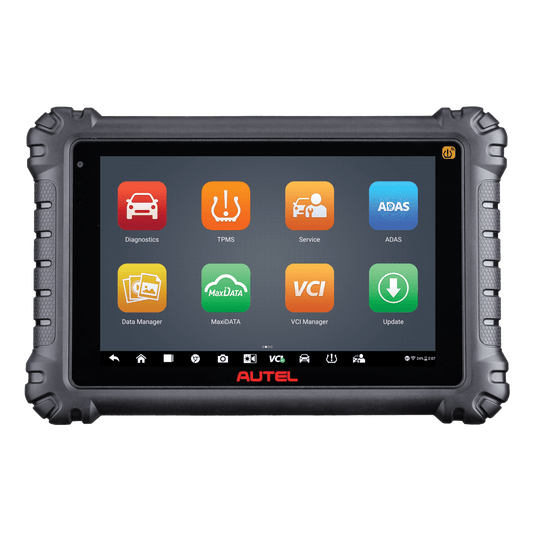
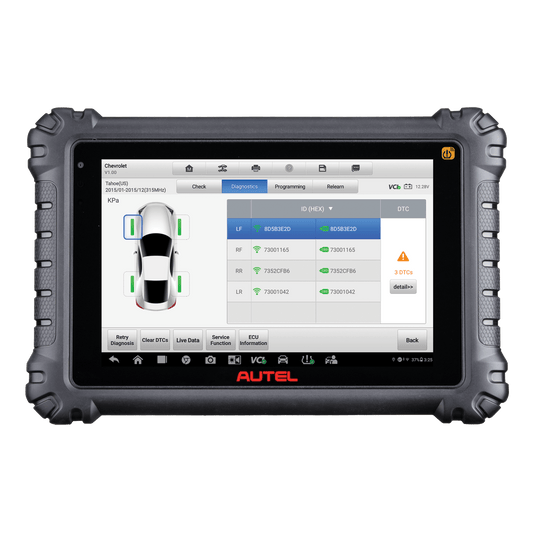
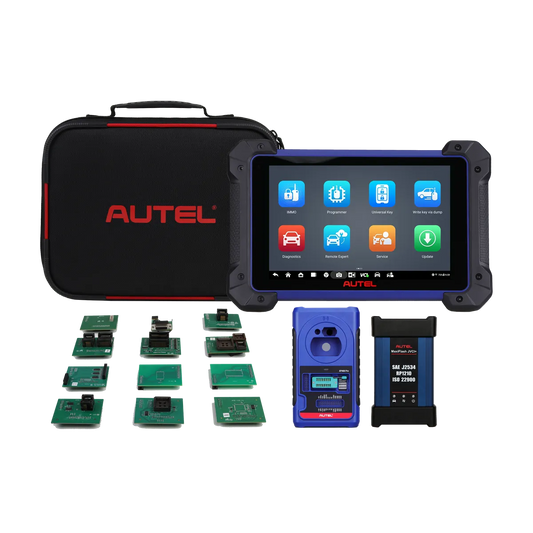
A TPMS diagnostic tool can activate, read, and diagnose TPMS sensors. It triggers each sensor to transmit its data (pressure, temperature, battery status, sensor ID) and identifies faulty sensors. Autel's MaxiTPMS line — including the TS508, TS608, and ITS600 — are among the most capable TPMS tools available, with coverage for virtually every TPMS sensor on the market.
Programmable Sensors
One of the biggest innovations in TPMS service is the universal programmable sensor. Instead of stocking hundreds of different OE sensor part numbers, shops can keep a single universal sensor in inventory and program it to match any vehicle. Autel's MX-Sensor is the industry-leading programmable TPMS sensor, available in both rubber valve stem and metal clamp-in configurations. A single MX-Sensor can be programmed to replace sensors for over 98% of vehicles on the road.
TPMS Service Kits
Every time a tire is serviced, the TPMS valve stem components should be replaced. Service kits include new valve cores, valve caps, grommets, and nuts. This is inexpensive preventive maintenance that avoids slow leaks and premature sensor failure.
TPMS Relearn Procedures
After any TPMS sensor replacement or tire rotation, the vehicle needs to "learn" which sensor is at which wheel position. There are three types of relearn procedures:
Stationary (OBD) Relearn
The TPMS tool connects to the vehicle's OBD2 port and writes the sensor IDs directly to the TPMS module. This is the fastest and most reliable method, taking just a few minutes. Most domestic vehicles (GM, Ford, Chrysler) and many Asian makes support this method.
Auto Relearn
The vehicle automatically learns the new sensor positions after driving for a period (typically 10-20 minutes at speeds above 15-25 mph). Some vehicles require specific procedures to enter relearn mode before driving. This method requires no special tools but takes more time.
Manual (Trigger) Relearn
The technician uses a TPMS tool to trigger each sensor in a specific sequence while the vehicle is in relearn mode. The vehicle's TPMS module records the sensor IDs based on the order they are triggered. This method is common on many Asian and European vehicles.
A professional TPMS tool like the Autel MaxiTPMS guides the technician through the correct procedure for each specific vehicle, eliminating guesswork.
The Business Case for TPMS Services
TPMS service is a natural add-on for any shop that handles tires. Here is why it makes good business sense:
- High frequency — Every tire service is an opportunity for TPMS work: rotations, replacements, seasonal swaps, and warning light diagnoses
- Good margins — Sensor replacement (parts + labor) typically commands $40-$80 per sensor. A four-sensor replacement job generates $160-$320 in revenue
- Customer retention — Shops that properly service TPMS build trust and repeat business. Customers return when the warning light comes on again
- Reduced comebacks — Properly servicing TPMS during every tire job prevents the customer from coming back a week later with a warning light
Common TPMS Mistakes to Avoid
- Ignoring the TPMS light — Never tell a customer "it is just the TPMS light." Diagnose it properly.
- Not replacing service kits — Reusing old valve cores and grommets is a recipe for slow leaks and callbacks.
- Skipping the relearn — After a rotation, the TPMS module may report pressure values for the wrong wheels. Always perform the relearn.
- Using incorrect sensor frequency — Different markets use different TPMS radio frequencies (315 MHz in the US, 433 MHz in Europe). Using the wrong frequency sensor will not work.
- Damaging sensors during tire service — Technicians must be careful during tire mounting and dismounting to avoid breaking sensor valve stems.
Getting Started with TPMS
Adding or improving your shop's TPMS capability is straightforward and affordable:
- Invest in a TPMS tool — An Autel MaxiTPMS diagnostic tool covers virtually all vehicles and guides you through every procedure.
- Stock programmable sensors — Keep a supply of Autel MX-Sensors on hand. They replace hundreds of OE part numbers, dramatically simplifying your inventory.
- Stock service kits — Valve cores, caps, grommets, and nuts for both rubber and metal valve stems.
- Train your techs — Make sure every technician understands the relearn procedure types and knows how to use the TPMS tool.
Ready to equip your shop for TPMS service? Call 866-217-0063 to discuss which Autel TPMS tools and sensors are right for your operation, or browse our TPMS product catalog.